Two weeks ago I released Paradee-8M-v1.2, which gave my small voice model four of Kokoro-82M’s English voices. Today I’m releasing Paradee-8M-v1.3. It’s one model with eight voices in four languages: English (American and British), Hindi, French and Spanish. The file is still 8.5 MB and it still runs about 62x faster than real time on one CPU thread.
Here’s a sentence about parakeets in each language.
In the wild, parakeets fly in loud, colorful flocks across the open grasslands of Australia.
These are the eight voices.
| Language | Voices |
|---|---|
| English (American) | Heart, Puck |
| English (British) | Isabella, Fable |
| Hindi | Alpha, Omega |
| French | Siwis |
| Spanish | Alex |
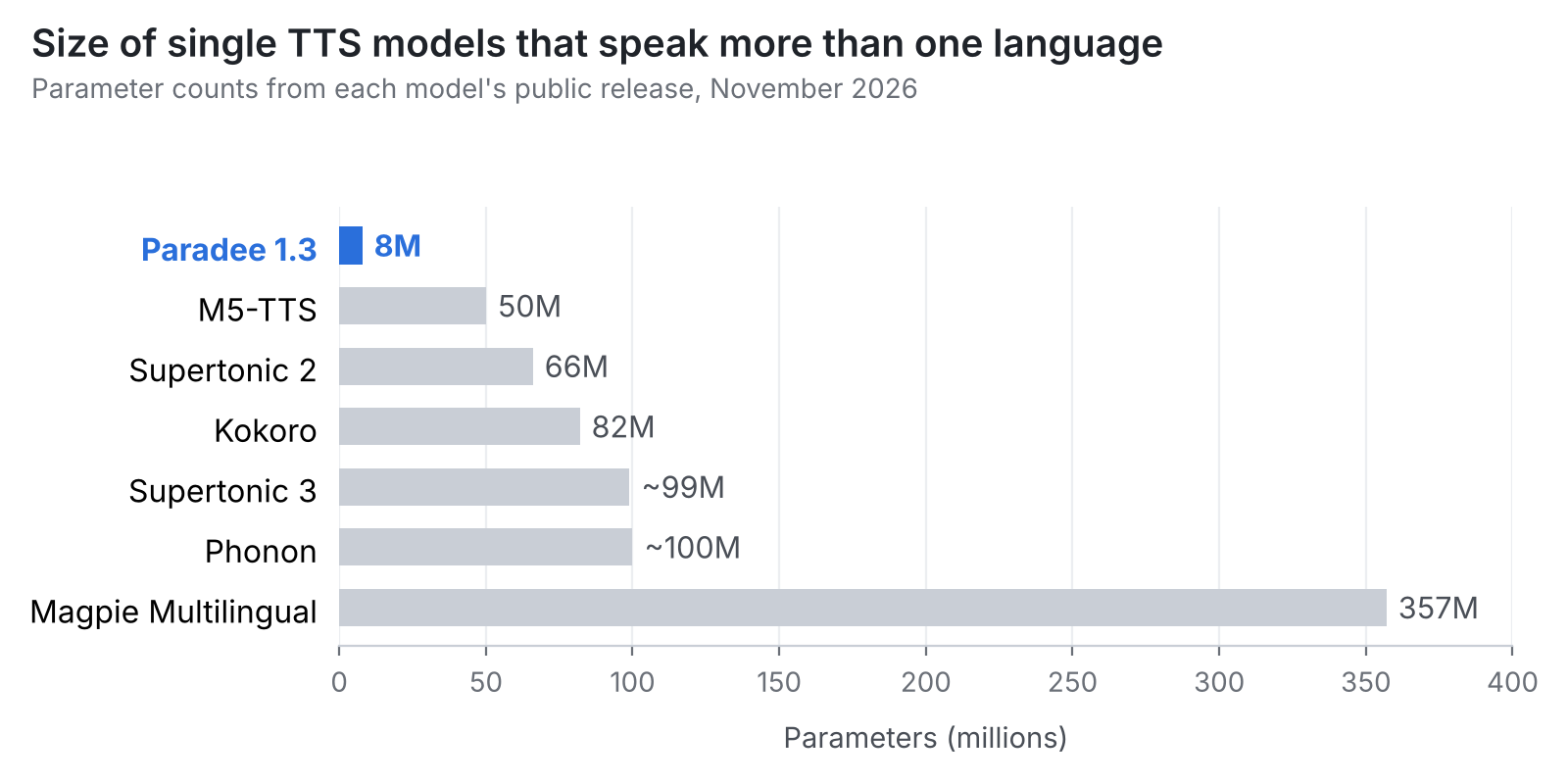
Paradee 1.3 is the smallest single TTS model that speaks more than one language. It’s about 6x smaller than the next smallest, M5-TTS, which has 50M parameters.
How Paradee learned to speak new languages
Paradee learns to convert phonemes, symbols that stand for sounds, into audio. Some phonemes are reused across languages, while other phonemes are unique to one language. Kokoro uses a constant set of 114 phonemes for every language it speaks. Since Paradee mirrors Kokoro’s architecture, it also has support for the same 114 phonemes. Until now, though, only the phonemes for English sounds had been trained. So Paradee had to learn how to map unfamiliar phonemes from new languages to sounds.
Each new voice also needed its own voice vector, a short list of numbers the model reads at every step. It sets the speaker’s pitch and tone, and also their rhythm, intonation and the way they say each sound, which is a big part of an accent. The same phoneme sounds different from a Hindi speaker than from an American one. Each new voice started as a copy of Heart’s vector and learned its own during training. The four new voice vectors add only 192 numbers, so the file stays the same size.
Each language also needs its own phonemizer, a program that turns written text into phonemes. Kokoro turns English into phonemes with its own dictionary. For Hindi, French and Spanish it uses eSpeak, a program that knows the pronunciation rules of many languages. Paradee does the same, and the voice you pick decides the language. Here is “Australia” in each one.
| Language | Word | Phonemes |
|---|---|---|
| English | Australia | ɔstɹˈAljə |
| Hindi | ऑस्ट्रेलिया | ɔsʈɾˈeːlɪjˌaː |
| French | Australie | ostʁalˈi |
| Spanish | Australia | Wstɾˈalja |
A and W are Kokoro’s shorthand for the sounds in “day” and “now”. The Hindi word has a ʈ, a t made with the tongue curled back, which English doesn’t have.
Scoring a multilingual model
| Voice | Language | UTMOS | NISQA | Word error rate |
|---|---|---|---|---|
| Heart | English | 4.38 / 4.52 | 4.93 / 5.00 | 2.7% / 3.0% |
| Puck | English | 4.35 / 4.47 | 5.01 / 5.04 | 2.8% / 3.0% |
| Isabella | English | 4.07 / 4.41 | 5.08 / 5.12 | 2.9% / 2.9% |
| Fable | English | 4.17 / 4.32 | 4.96 / 5.00 | 2.7% / 3.0% |
| Alpha | Hindi | 3.99 / 4.29 | 3.98 / 4.37 | 21.7% / 20.7% |
| Omega | Hindi | 3.82 / 4.09 | 4.57 / 4.73 | 21.6% / 19.8% |
| Siwis | French | 3.45 / 3.65 | 4.39 / 4.65 | 6.8% / 6.8% |
| Alex | Spanish | 3.14 / 3.34 | 4.72 / 4.98 | 5.0% / 5.1% |
Each cell is Paradee, then Kokoro, on 200 held-out sentences per voice. UTMOS and NISQA predict how a listener would rate the audio from 1 to 5. Word error rate is the share of words that Whisper large-v3 gets wrong when it transcribes the audio in its own language.
UTMOS and NISQA were trained mostly on English recordings, so for Hindi, French and Spanish their scores are not a great metric for voice naturalness. However, we can compare Paradee’s scores to Kokoro’s scores for an idea of how similar Paradee sounds to Kokoro. Hindi word error rates are high for both models because many Hindi words have more than one accepted spelling. The model card also lists character error rates, which count single letters and don’t have that problem.
One model or one per language
One question I wanted to explore in making Paradee multilingual is the following: Is there quality loss from squeezing so many voices and languages into a tiny model?
In order to investigate that question, I trained multiple single-language Paradee models along with the shared multilingual model. I then compared the performance of the multilingual model against the language-specific models.
The English voices score the same as in 1.2 (UTMOS within 0.03 for every voice), so adding the new languages didn’t cost them any quality. French also came out the same as the French-only model. Hindi lost a little. The Hindi-only model sounded slightly cleaner (NISQA 0.15 to 0.2 higher) with the same error rate, though this difference is minimal. When listening to the models side-by-side, it was hard for me to notice any difference.
Based on these results, it seems that there may be slight quality loss from having a single multilingual model compared to multiple single-language models at this size. However, this loss is minimal, not across all languages, and a human listener could not tell the difference.
What’s Next?
Next I want to add support for more languages. Currently, Paradee can only learn a language from its teacher Kokoro. I want to explore if we can add more languages from Kokoro without losing quality, and whether it is possible to add new languages that are not supported by Kokoro. I also want to explore code-switching, where one sentence mixes two languages, like Hindi with English words in it.
Try it
Paradee-8M-v1.3 is the light voice in Chickadee, a Chrome extension that reads web pages aloud using local voice models. Version 1.5.0 lists the voices by language. Choose Paradee as the model and pick a voice.
The Python package uses 1.3 by default, and 1.2 and 1.1 are still available.
pip install git+https://github.com/sahilmahendrakar/paradee
python -m paradee "Paradee est une petite voix qui fonctionne partout." --voice ff_siwis -o bonjour.wav
Links
- Model: Hugging Face
- Code: GitHub
- Chickadee: Chrome Web Store
- Paper (describes v1.0): arXiv
- Earlier posts: Paradee 1.2, Paradee 1.1, Paradee